
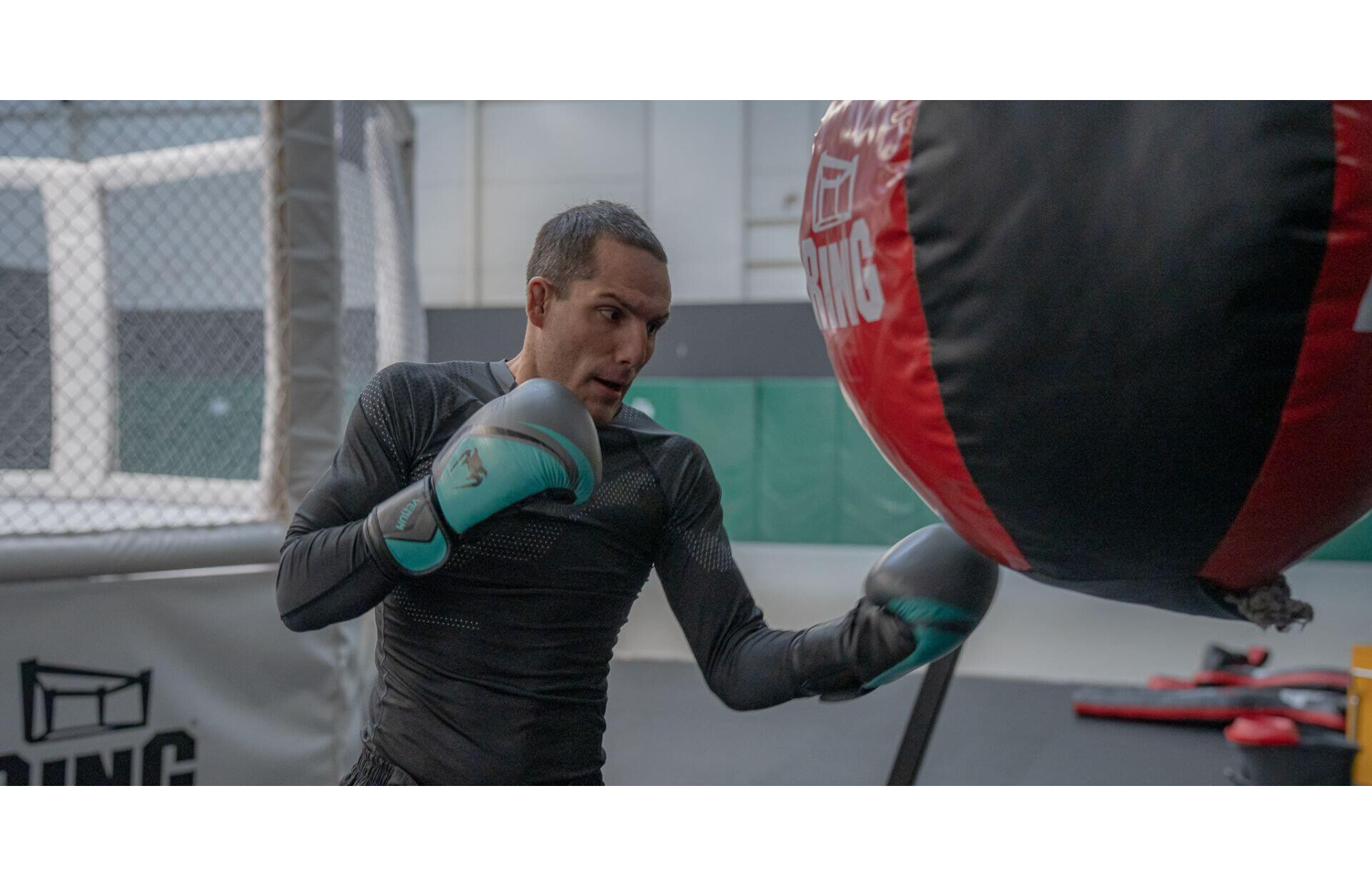
Boxing - what is it and what is the sport of boxing about?
Two people stand opposite each other. Each has just one goal - to do everything possible to be better, outscore the opponent or knock them to the canvas and make sure it is their hand that the referee raises in victory. You have to admit, that is quite a neat way to describe the sport of boxing, right? Want to learn a bit more about it? Let’s dive in!
Learn the definition and rules that apply in professional and amateur boxing. How do you get started and what is worth knowing? You will find that and plenty of other useful tips here.
What is boxing?
Boxing (box, boxing, prizefighting) is a sport whose origins go all the way back to ancient Greece. Back then, however, it was much more brutal in nature. Fights were contested with bare fists, which meant competitors often came out of them badly battered and, in extreme cases, died (in the ring or afterwards).
A more civilised version of boxing appeared hundreds of years later - specifically in 18th-century England. Even then, fights were still held without gloves. The requirement to wear them came more than 100 years later - and from that point on, we can safely say that the sport began to become more civilised and to take fighters’ safety into account.
In the years that followed, new rules were introduced - such as dividing a fight into 15 (and later 12) rounds of 3 minutes each, as well as adding a scoring system (initially, a contest ended when one of the fighters was unable to continue). The fighting area was also standardised - a roped ring of appropriate dimensions. In amateur boxing, one side measures 4.3 - 6.1 m. In professional boxing, it is 5.9 - 6.1 m.
Through all those years, however, one thing has remained unchanged. Boxing is a contest in which 2 fighters face each other. If you are interested in other combat sports, be sure to read about MMA, which we covered in a separate post on the SMMASH blog.
Famous boxers - Poland and the world
Until quite recently, boxing was one of the most popular combat sports, attracting huge numbers of fans (both in front of their TVs and directly to arenas). Among the leading representatives of the sport are such famous and respected names as Muhammad Ali, Mike Tyson, Evander Holyfield, Riddick Bowe, Roy Jones Jr. and Oscar de la Hoya.
In this respect, our country has nothing to be ashamed of either. Polish boxers who gained worldwide fame and recognition include Andrzej Gołota, Dariusz Michalczewski and Krzysztof Włodarczyk. Our representatives have performed (and still perform) brilliantly in both amateur and professional boxing.
How boxing matches unfold and how they end
Each round begins with the referee signalling the start of the action. All boxing competition takes place in a standing position, and the only strikes fighters may use are punches thrown with hands protected by gloves. The most popular attacking techniques include straight punches, hooks and uppercuts. Boxers can target both the face and the torso of their opponent.
Defensive positions, in turn, include those that block incoming punches (for example, the guard), as well as those aimed at completely avoiding a strike (step back, lean back, clinch, etc.).
A boxing match can end by:
- Knockout - when the opponent falls to the ring and does not get up while the referee counts to 10. A situation in which a fighter gets up after such a blow is called a knockdown. If it happens 3 times in one round, it means an automatic win for the opponent.
- Points decision - when the fight goes the full distance, three independent judges decide the result. For each round, they award a specific number of points (10 points for the winner and 9 for the loser). At the end, the points are added up.
- Breaking the rules - when a fighter does not compete in accordance with the rules.
A boxing match may also be stopped if one of the fighters is unable to continue. Such situations happen, especially when a serious injury is sustained.
Prohibited actions in the ring. What are you NOT allowed to do?
Apart from the things fighters are allowed to do, there is also a whole list of actions that are strictly forbidden. These include, for example:
- Blows below the belt, to the back of the head, the back and the kidneys.
- Throwing strikes with an open hand, elbows, legs or the head (as well as biting).
- Holding, pushing or pulling the opponent.
- Attacking after the round has ended.
Committing one or more of the above “offences” may result in points being deducted, a warning or, ultimately, the disqualification of the fighter who committed them.
Types of boxing matches - what is worth knowing?
As in many other combat sports, boxing also follows certain rules regarding the number and duration of rounds, scoring, clothing and equipment, as well as permitted punches and prohibited behaviour.
Today, these rules are determined mainly by the specific type of contest. In this area, we distinguish:
- Amateur boxing (also called Olympic boxing), in which mainly young and aspiring fighters compete. The competition includes national championships, world championships and Olympic medals.
- Professional boxing, meaning the form you know mainly from television and major international events. In this case, boxers fight for the titles of independent federations and also… huge money.
Most fighters begin their careers in Olympic boxing and then develop and continue them in the professional ring. There is no move back from professional boxing to amateur boxing.
Amateur (Olympic) boxing
Amateur bouts are divided into 3 rounds (each lasting 3 minutes). Competitors wear vests or tops (one in red, the other in blue). Until recently, there was also a requirement to wear special protective headgear, but this has already been withdrawn.
The weight categories in amateur boxing are:
- light flyweight: 46 - 49 kg
- flyweight: up to 52 kg
- bantamweight: up to 56 kg
- lightweight: up to 60 kg
- light welterweight: up to 63,5
- welterweight: up to 69 kg
- middleweight: up to 75 kg
- light heavyweight: up to 81 kg
- heavyweight: up to 91 kg
- super heavyweight: over 91 kg
Professional boxing
Professional contests can last from 9 up to as many as 12 rounds (the duration of a single round is 3 minutes for men and 2 minutes for women). Fighters compete without tops and without headgear.
Weight categories in which professional boxers compete
As you are about to see, the division here is broader and definitely more detailed.
- minimumweight: up to 47,627 kg
- junior flyweight / light flyweight: up to 48,998 kg
- flyweight: up to 50,820 kg
- junior bantamweight / super flyweight: up to 52,163 kg
- bantamweight: up to 53,524 kg
- junior featherweight / super bantamweight: up to 55,338 kg
- featherweight: up to 57,153 kg
- junior lightweight / super featherweight: up to 58,967 kg
- lightweight: up to 61,235 kg
- junior welterweight / light welterweight: up to 63,503 kg
- welterweight: up to 66,678 kg
- junior middleweight / super welterweight: up to 69,853 kg
- middleweight: up to 72,575 kg
- super middleweight: up to 76,204 kg
- light heavyweight: up to 79,379 kg
- junior heavyweight / cruiserweight: up to 90,719 kg
- heavyweight: over 90,719 kg
Equipment and clothing for boxing
The basic accessories for every boxer are:
- Dedicated boxing gloves (full gloves, without exposed fingers, with padding that cushions the force of punches). Under the gloves, special wraps / tapes are used to provide stability and better protection.
- Fight shorts (usually with loose legs).
- Boxing shoes (lace-up and extending above the ankle).
- Protective gear (for the teeth and groin).
How and what should you use to train boxing?
When it comes to training for such bouts, the boxing arsenal is much broader. In addition to the gloves, clothing, protective gear and footwear mentioned above, training also makes use of heavy bags and speed bags, as well as heads mounted on special springs.
Boxing training should not focus only on technical aspects. Just as important as correct punching technique are tactics, strength and conditioning. That is why regular boxing sessions should include:
- Sparring (bouts with other fighters).
- Cardio exercises (running, skipping rope).
- Gym training (using weights and machines).
Most of these elements can be done at home or in the gym. However, if you want to develop in this combat sport, we recommend looking for boxing classes organised in your area.
Is it worth it? What are the benefits of boxing training?
Leaving aside those for whom this sport is a way of life and a source of income, it is worth bearing in mind that this martial art is also an excellent step towards staying fit and spending time actively.
It can be an interesting option as a hobby - especially for younger people. For slightly older people, on the other hand, it may turn out to be a solution that helps improve fitness, overall physical ability and also brings a great deal of satisfaction.
Boxing clothing (and more) to help you start training boxing?
If you are looking for it, be sure to check out the SMMASH online sportswear store. There you will find T-shirts, hoodies, trousers, jackets and shorts that will let you dress comfortably and stylishly - “from head to toe”. We invite both boxing fans and fans of other martial arts to shop with us.


