
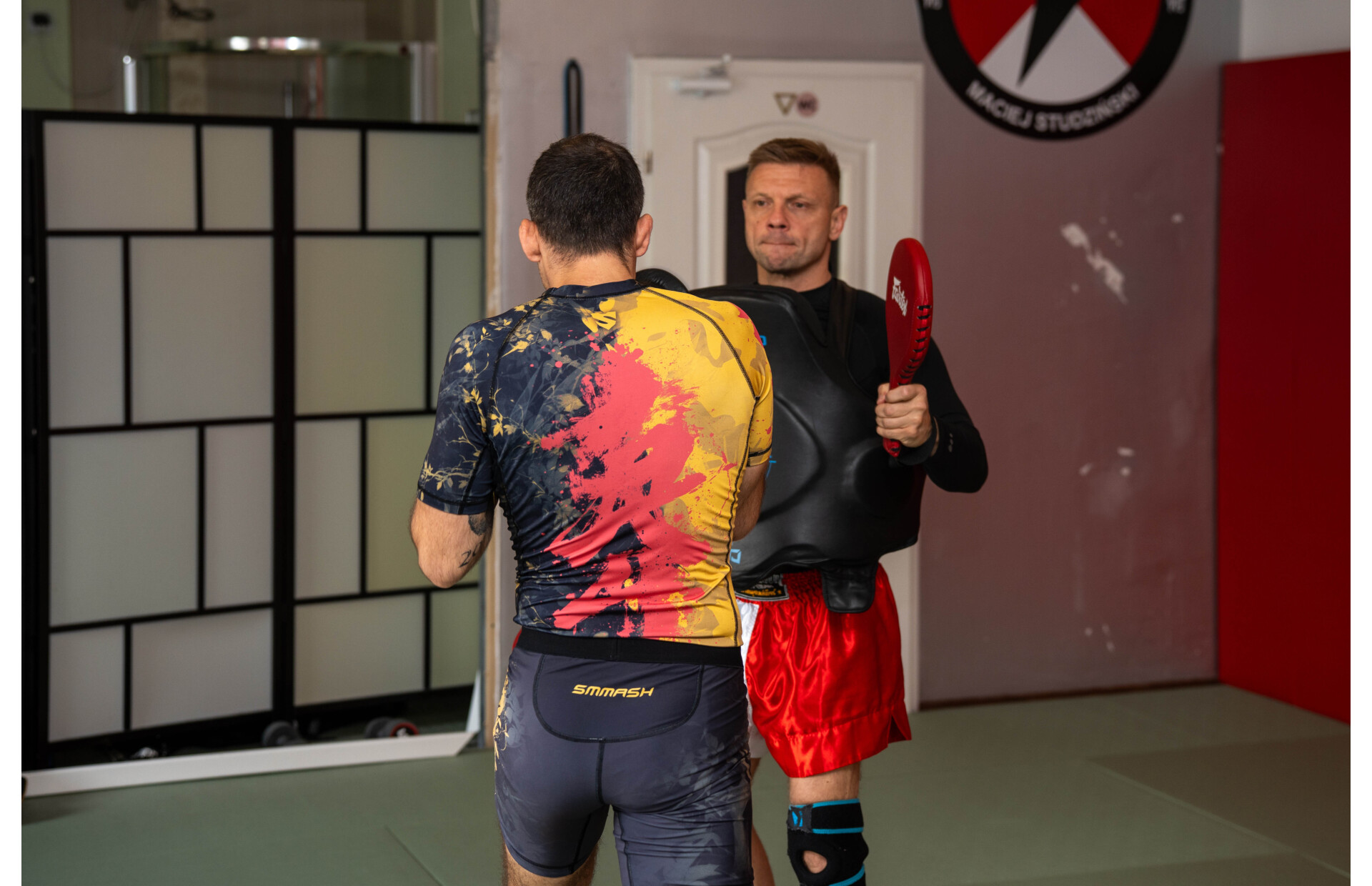
Rashguard vs thermoactive shirt - differences, purpose and what to choose?
From a distance, they may seem almost identical. After all, both fit close to the body, both are made from synthetic fibres, and both come in short-sleeve and long-sleeve versions. In practice, however, we are talking about two completely different categories of sportswear.
What is the difference between a rashguard and a thermoactive shirt, and what should you look for when choosing one to match the sport you train? Let’s take a look.
Why are these two products so often confused?
Why is there such a common belief that a rashguard and a thermoactive shirt are the same thing? We can only assume that it comes from the fact that these two products share quite a few features. After all, both fit tightly to the body, are made from synthetic fibres, and are also durable, flexible and effective at wicking away moisture.
And that’s exactly what makes the difference seem purely cosmetic at first glance, so both categories are often treated as interchangeable.
What is the difference between a rashguard and a thermoactive shirt?
The main differences lie in the construction, fabric composition and the details that often go unnoticed in product photos.
- Rashguards are designed for combat sports such as MMA, Muay Thai, BJJ and many others. Their knit is therefore dense and durable, as it needs to withstand grips, friction against the mat and the force of a training partner during grappling.
- Thermoactive shirts, on the other hand, are made with maximum thermoregulation and efficient moisture management in mind. Yes, they are durable too, but not to the same extent as typical rashguards. They have a slightly lighter structure and, in addition, special mesh-covered areas (for example under the arms).
Compression
This is the parameter responsible for improving blood circulation during exercise, reducing micro-vibrations during dynamic movement, stabilising the work of muscles and tendons and also speeding up recovery after training. Both types of shirt may have it, but they do not have to. What matters is that they fit the body well. Any additional pressure, however, is already an individual matter for each athlete.
Sweat and moisture management
Thanks to its close fit, a rashguard absorbs sweat across the entire surface of the body. But its breathability is limited because the knit remains dense and durable. That is why, during very intense and prolonged effort, it can create the feeling of damp skin. A thermoactive shirt, in turn, is better optimised for heavy sweating. It has mesh panels, better breathability and much faster moisture transfer to the outer layers.
Durability
A good-quality rashguard, with regular use (3 - 5 training sessions per week), lasts 2 - 4 years. It withstands hundreds of wash cycles as well as equally intense contact with the mat. Dense knitting and reinforcements in key areas make it resistant to tears, snags and mechanical damage. A thermoactive shirt is a bit more delicate. However, with sensible use, it can last just as long.
Purpose (disciplines and sports)
A rashguard is suitable for Brazilian jiu-jitsu (BJJ) no-gi, MMA, grappling and many other combat sports. In all of these applications, mechanical skin protection is crucial rather than thermoregulation.
A thermoactive shirt, in turn, works well for:
- gym training and Crossfit - comfort, freedom of movement and efficient moisture management,
- running (short and long distance) - sweat wicking and no chafing from seams,
- skiing and snowboarding - as a base layer under a jacket and trousers, moving sweat outwards in low temperatures,
- road cycling and mountain biking - breathability and even a light cooling effect on the body,
- trekking and climbing - temperature regulation during effort.
Can you use a rashguard instead of a thermoactive shirt (and vice versa)?
Yes, you can, although in our opinion it does not make much sense.
- Rashguard instead of a thermoactive shirt works occasionally, for example as a base layer under a sweatshirt at the gym. But for long cardio sessions or running, it simply is not suitable. It lacks the thermoregulation effect and breathability, while the dense knit quickly 'holds' moisture that it then cannot efficiently move away.
- Thermoactive shirt instead of a rashguard - in combat sports, this is almost always a poor choice. It is not made for such intense use, which means it may give out after just a few or a dozen training sessions.
When should you choose a rashguard, and when should you go for a thermoactive shirt?
Time for a clear summary that will make your decision and shopping easier (hopefully in our store).
Choose a rashguard if:
- you train combat sports (BJJ, MMA, grappling, submission wrestling),
- you want compression support at the gym or during Crossfit,
- you need mechanical skin protection during contact training.
Choose a thermoactive shirt if:
- you run or do other disciplines involving prolonged effort,
- you need a base layer under other clothing,
- your activity requires thermoregulation,
- you prefer better breathability.
Looking for sports shirts that work for your discipline?
At SMMASH, we have a full range for you - for both men and women. In the range, you will find models dedicated to combat sports, functional training and running. All with Polish production, proven technologies and designs you will simply want to train in. And if you want something truly unique, design your own rashguard in the X-CREATOR configurator.


