
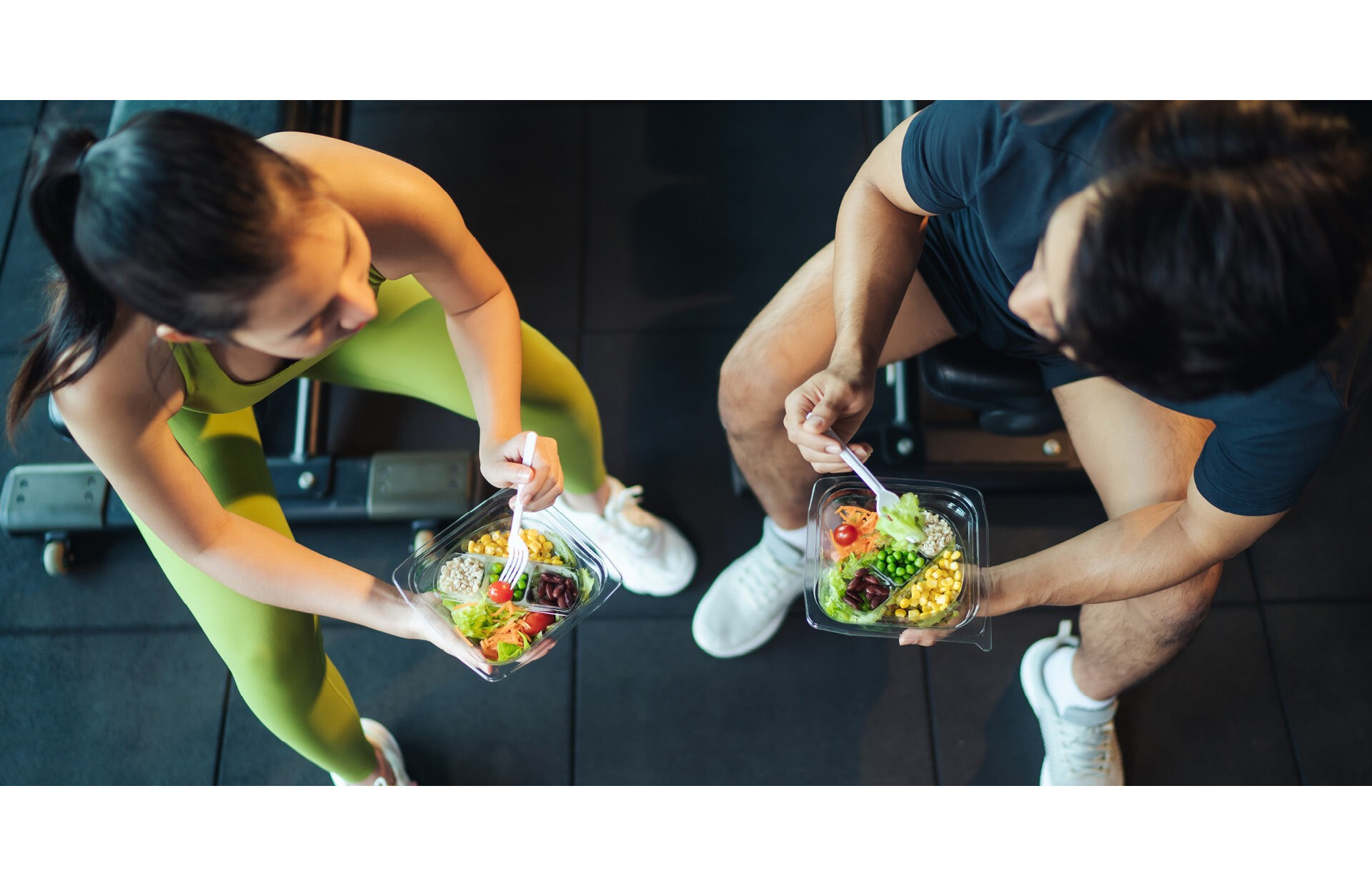
What to eat before a workout? A meal worth planning before the gym and other exercise.
Eat “before”, or maybe only “after” a workout? This is definitely one of the questions most often asked by beginners who are planning to start or are taking their first steps in the gym, training hall, or are beginning to attend sports classes. If you are one of them, we hope you will find all the essential information in this post.
As you can probably guess, the topic of pre- and post-workout meals is not straightforward and requires looking into both areas separately. That is why here we will focus on what happens before you start exercising, meaning what exactly is worth eating before a workout.
How should you plan your diet so that it provides the essential nutrients, gives you strength, and at the same time lets you perform at your best in every training session? Check it out!
Why is eating the right food before a workout so important?
Your body is like a car. Without fuel (or increasingly often, electricity), it simply will not go anywhere. Of course, in the case of your body, we are not talking about petrol, gas, diesel, or electricity, but about the energy provided by... food!
You could say that a properly planned meal is a kind of backup your body can draw on during physical activity. All so you can maintain the right quality of your training session and successfully complete every gym workout, class, or other type of exercise.
Which macronutrients should be included in a pre-workout meal?
As you have probably already guessed, your pre-workout meal should contain all 3 essential macronutrients, namely:
- Carbohydrates, which are the basic driving force for your body. In other words, they provide the energy that allows you to perform at full capacity. Proven sources of carbs include rice, groats, selected vegetables, and fruit.
- Protein, which is both the building block of muscles (and supports their growth) and a way to regenerate and protect the muscle mass you already have. Excellent sources of protein include meat (especially poultry) and fish. You can also consider supplementation.
- Fats, which are a source of valuable nutrients that support various bodily functions. It is worth getting this nutrient from foods such as nuts, seeds, and olive oil.
There is, however, one important “BUT!”. Their selection, and therefore the exact amount, should be matched both to the type of activity you do, your body weight, and the goals you want to achieve.
It is probably no surprise that a “hefty” 1,000-calorie dinner will not be the best solution for a small and slim woman. On the other hand, a light bowl of porridge with fruit may prove insufficient for a man who is planning to throw some iron around in the gym. Right ;)?

How to plan a pre-workout meal? A step-by-step guide.
Here is a short guide that will help you take care of every aspect. Check out 4 important steps that should not be missed when planning your diet before physical activity.
Step 1: match it to the type of activity
The first factor you need to take into account is the discipline. It largely determines not only the amount of pre-workout food, but also how rich it should be in specific macronutrients.
If your activity is dominated by classic strength training (lifting weights), you certainly should not miss a solid portion of protein, carbohydrates, and a little fat. If you do fast and intense workouts (Crossfit, HIIT, etc.), it is worth placing much greater emphasis on making sure you get the right amount of carbohydrates.
Step 2: determine your needs and capabilities
Remember that when planning your pre-workout diet, you should also take into account such important aspects as your weight, height, and the goals you want to achieve.
Step 3: prepare your meals
A properly selected diet is important from the perspective of your health and physical performance, but it also has another important goal - it should simply taste good to you. If something does not quite suit your taste, do not be afraid to experiment and freely swap ingredients around (within reason). And if you are not gifted in the kitchen, ask someone close to you for help or simply start using a meal delivery service :).
Step 4: check how your body reacts to them
Remember that a diet that is a real lifesaver for one athlete may not work the same way for you at all. That is why you should analyse how you feel after eating specific meals. Check your well-being, the quality of your training, any progress (or regression), and also what your recovery looks like.

What should you NOT eat before a workout (or at least what do we not recommend)?
If we had to point to one nutrient that should be approached with great caution, it would certainly be fat. It has the characteristic that the digestion process takes a very long time, and as a result, it puts a heavy strain on your digestive system.
The conclusion? Leave fried or heavily fatty dishes for “after the workout”. “Before”, stick only to small amounts of this macronutrient, which you can find, among other things, in nuts and seeds.
How long before a workout should you eat your last meal?
The general rule says that you should eat your last meal around 2-3 hours before your planned workout. Of course, in this case we mean a proper, filling meal. Around an hour (up to 40 minutes at most) before activity, you can allow yourself a small snack, but after that you should only take in fluids.
Why is this so important? First of all, it is about the feeling of heaviness and indigestion. If you eat too much right before your workout, you can be sure that certain discomforts will catch up with you, making physical activity difficult and, in many cases, even impossible. Hiccups, heartburn, and stomach pain are definitely the smallest of the problems that may appear then.
Worth remembering!
Keep in mind that the information above is only a foundation and a general guide that should be adapted to your individual needs.
What, apart from food, affects the quality of your training?
You have to admit that a properly planned menu is a real foundation, without which it is impossible to build fitness, physique, and above all to ensure the right amount of energy that lets you give your all. When establishing and, especially, sticking to a balanced diet becomes your “normal”, remember to also take care of proper training clothing.
At SMMASH, a wide selection is waiting for you, making it easy to find sportswear matched to your discipline. You can choose, among other things, functional, durable, and designer rashguards, training shorts, and if you want, also sports leggings and much, much more. In addition to plenty of ready-made designs, you can create your own fully unique clothing. All you need to do is use our intuitive tool called X-CREATOR.


